Accession Data:
Carnegiea gigantea (Englm.) Britt. and Rose
- Common Name: Saguaro
- Family: Cactaceae Juss.
- Synonym(s): Cereus giganteus Engelm.
- Country of Origin: Southern Arizona, southeast California and northwest Mexico
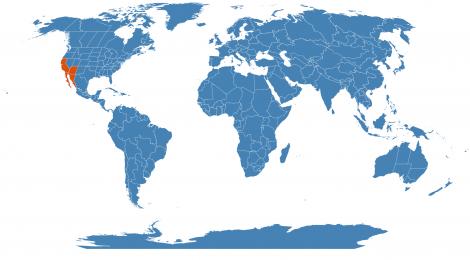
- Habitat: Sonoran desert
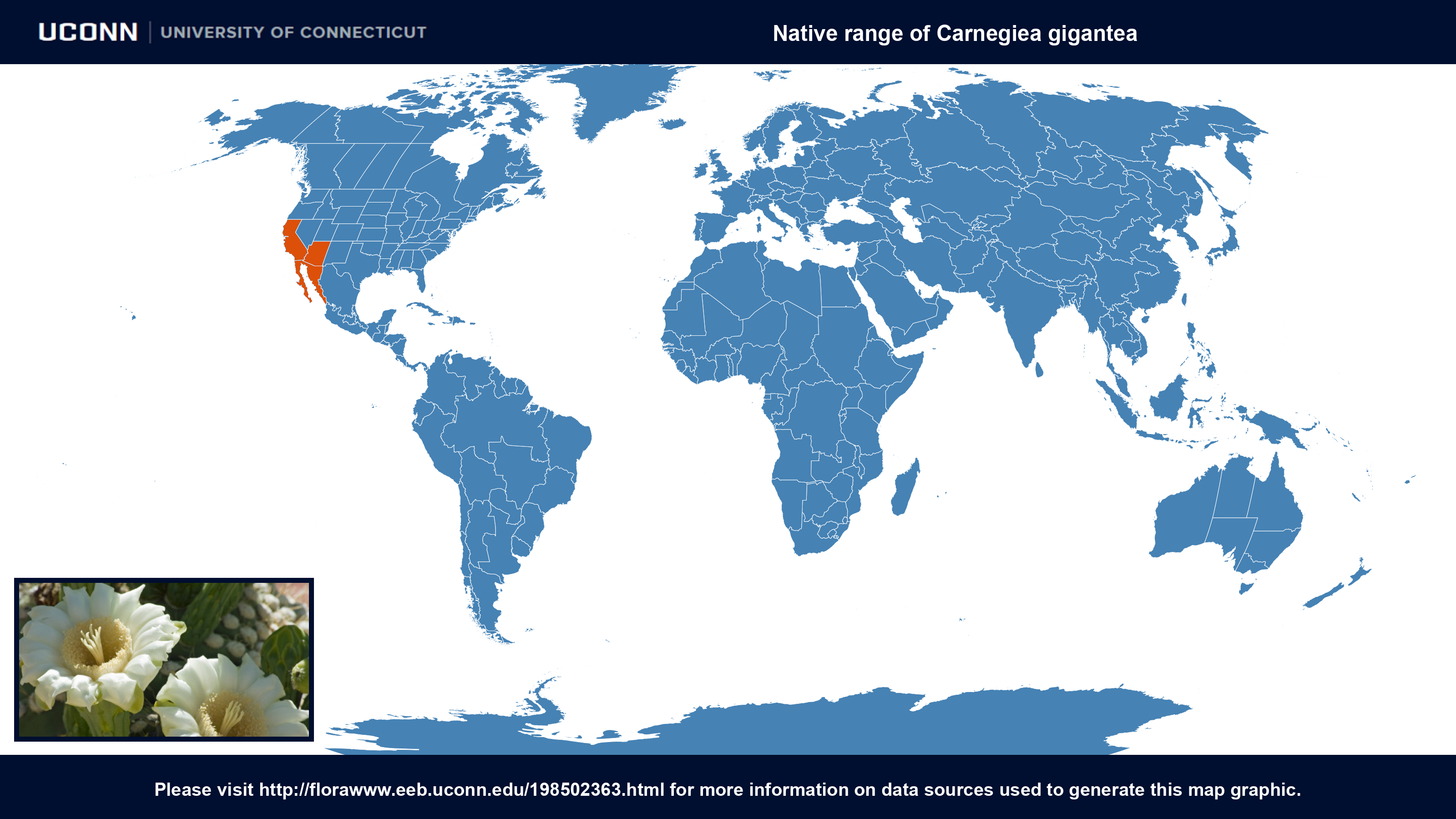
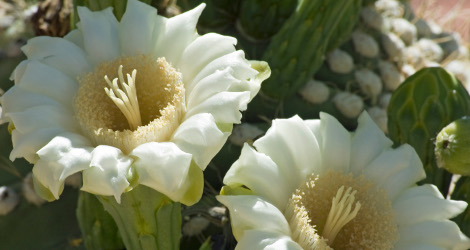
- Description: Large, columnar, ribbed stem to 60 feet high and 2 feet thick, ribs 12-30; spines 20-25, gray, needle-shaped to awl-shaped, 1/2 to 3 inches long, yellow in upper areoles; flowers white, to 5 inches long, closing next afternoon; fruit oblong, red, to 3 inches in diameter, edible. Spring and summer.
This is the largest member of the Cactaceae and can reach 12 tons in weight and alleged to live more than 200 years. Pollinated by birds and insects by day, bats by night.
Sometimes transplanted from the wild but not thriving in cultivation.
- Uses: This plant has been important as a food and drink and is still collected and used in ceremonies.
- Culture: In a low-humidity, low-rainfall climate this cactus is suitable for garden or container cultivation, though it is not very easy to grow away from its native climate. Plant in humus-rich, gritty, very well-drained soil in full sun. Propagate from seed or offsets.
- USDA Zone: 9-11
Accession Data:
- Accession # 198502363
- Source: Unknown
- Accession Date: 12-31-1985
- Bench: 2213 - XER:Sonoran-Baja Deserts
- Currently: active - healthy
- Qty: 2 confirmed on 05-20-2025
- Restrictions:
- CITES Appendix II Listed Plant
- CITES Appendix II Listed Plant
Classification:
- Division: Magnoliophyta
- Class: Magnoliopsida
- SubClass: core eudicots
- Order: Caryophyllales
- SubOrder:
- Family: Cactaceae
- SubFamily: Cactoideae
- Tribe: Phyllocacteae
- SubTribe: Echinocereinae
References (internal):
- Bat Pollinated (chiropterophily)
- Pollination Syndrome Scavenger Hunt
- Plants with Extrafloral Nectaries
- EEB 3271 - Systematic Botany
- EEB Greenhouse Holdings native to: Arizona / California / Mexico Northwest
References (external):
- Hortus Third, LH Bailey Hortorium, 1976
- Botanica, Turner & Wasson, 1997, CD-ROM Version
- Image #00 (cropped) & #01 (original) by Ken Bosma [CC BY 2.0], via Wikimedia Commons. Last accessed on Monday, March 05, 2018.
_blossoms.jpg)
data regenerated on Thu, 03 Jul 2025 15:33:11 -0400 [bcm v4.0]
Images:
Additional images for this accession:
Click on thumbnails to enlarge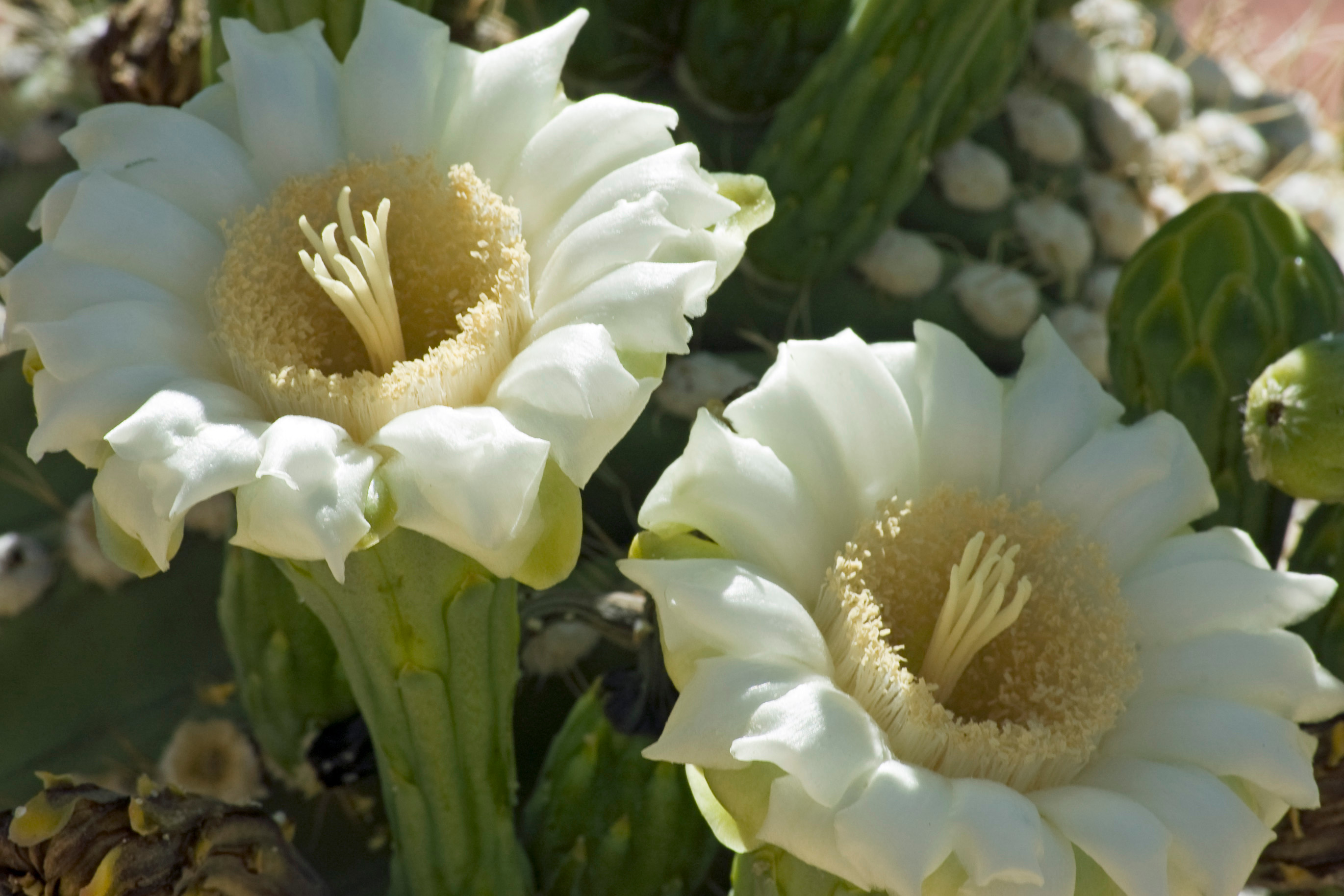
Current Accessions in the Cactaceae
Subfamily Cactoideae
Tribe Cacteae
- Ariocarpus fissuratus


- Astrophytum capricorne
- Astrophytum myriostigma
- Astrophytum ornatum W/C
- Coryphantha cornifera W/C
- Coryphantha difficilis
- Coryphantha maiz-tablasensis W/C
- Echinocactus grusonii
- Echinocactus texensis W/C
- Epithelantha micromeris W/C
- Escobaria vivipara W/C
- Ferocactus cylindraceus W/C
- Ferocactus echidne W/C
- Ferocactus glaucescens W/C
- Ferocactus glaucescens
- Ferocactus gracilis
- Ferocactus pilosus
- Leuchtenbergia principis
- Mammillaria bocasana
- Mammillaria bombycina
- Mammillaria compressa
- Mammillaria compressa
- Mammillaria glochidiata W/C
- Mammillaria gracilis ssp. minima
- Mammillaria hertrichiana W/C
- Mammillaria hertrichiana W/C
- Mammillaria magnimamma
- Mammillaria mystax
- Mammillaria parkinsonii W/C
- Mammillaria petterssonii W/C
- Mammillaria plumosa
- Mammillaria scheideana W/C
- Mammillaria uncinata W/C
- Mammilloydia candida W/C
- Ortegocactus macdougallii
- Rhipsalidopsis gaertneri

- Stenocactus crispatus W/C
- Stenocactus lamellosus W/C
- Thelocactus rinconensis W/C
- Turbinicarpus jauernigii
Subfamily Cactoideae
Tribe Cereeae
- Cereinae: Cereus forbesii
- Cereinae: Cereus hildmannianus W/C
- Cereinae: Cereus repandus
- Cereinae: Cereus repandus var. monstrosus
- Cereinae: Cipocereus bradei
- Cereinae: Disocactus flagelliformis
- Cereinae: Melocactus azureus
- Cereinae: Melocactus cf. disciformis
- Cereinae: Melocactus ernestii
- Cereinae: Melocactus intortus W/C
- Cereinae: Melocactus matanzanus
- Cereinae: Pilosocereus magnificus
- Cereinae: Pilosocereus pachycladus W/C
- Cereinae: Pilosocereus polygonus W/C
- Cereinae: Pilosocereus purpusii
- Cereinae: Pilosocereus sp.
- Rebutiinae: Browningia hertlingianus
- Rebutiinae: Gymnocalycium capillaense W/C
- Rebutiinae: Gymnocalycium gibbosum W/C
- Rebutiinae: Gymnocalycium monvillei ssp. achirasense W/C
- Rebutiinae: Gymnocalycium pflanzii W/C
- Rebutiinae: Gymnocalycium quehlianum W/C
- Rebutiinae: Rebutia minuscula W/C
- Rebutiinae: Uebelmannia pectinifera
- Trichocereinae: Acanthocalycium klimpelianum W/C
- Trichocereinae: Acanthocalycium klimpelianum W/C
- Trichocereinae: Cleistocactus baumannii ssp. santacruzensis
- Trichocereinae: Cleistocactus fieldianus W/C
- Trichocereinae: Cleistocactus strausii
- Trichocereinae: Discocactus placentiformis
- Trichocereinae: Echinopsis ancistrophora ssp. arachnacantha
- Trichocereinae: Echinopsis atacamensis W/C
- Trichocereinae: Echinopsis aurea W/C
- Trichocereinae: Echinopsis aurea
- Trichocereinae: Echinopsis aurea W/C
- Trichocereinae: Echinopsis calochlora
- Trichocereinae: Echinopsis camarguensis
- Trichocereinae: Echinopsis eyriesii
- Trichocereinae: Echinopsis subdenudata
- Trichocereinae: Echinopsis thionanthum W/C
- Trichocereinae: Espostoa ritteri W/C
- Trichocereinae: Espostoa senilis
- Trichocereinae: Haageocereus chryseus W/C
- Trichocereinae: Haageocereus salmonoides
- Trichocereinae: Harrisia regelii W/C
- Trichocereinae: Harrisia taetra W/C
- Trichocereinae: Lobivia pygmaea
- Trichocereinae: Matucana calliantha
- Trichocereinae: Matucana madisoniorum
- Trichocereinae: Oreocereus celsianus W/C
- Trichocereinae: Oreocereus cf. celsianus
- Trichocereinae: Trichocereus grandiflorus
- Trichocereinae: Weberbauerocereus rauhii W/C
Subfamily Cactoideae
Tribe Copiapoinae
- Copiapoa cinerea W/C
- Copiapoa cinerea var. haseltoniana
- Copiapoa coquimbana W/C
- Copiapoa echinoides
- Copiapoa echinoides W/C
- Copiapoa humilis
- Copiapoa hypogaea W/C
- Copiapoa laui W/C
- Copiapoa montana W/C
- Copiapoa montana
- Copiapoa unidentified
- Frailea cf. pygmaea
Subfamily Cactoideae
Tribe Notocacteae
- Neoporteriinae: Eriosyce napina W/C
- Neoporteriinae: Eulychnia breviflora W/C
- Neoporteriinae: Eulychnia breviflora
- Neoporteriinae: Eulychnia saint-pieana
- Notocactinae: Parodia comarapana
- Notocactinae: Parodia formose var. prolifera
- Notocactinae: Parodia haselbergii ssp. haselbergii
- Notocactinae: Parodia leninghausii
- Notocactinae: Parodia magnifica
- Notocactinae: Parodia ottonis
Subfamily Cactoideae
Tribe Phyllocacteae
- Corryocactinae: Neoraimondia arequipensis W/C
- Echinocereinae: Acanthocereus tetragonus
- Echinocereinae: Carnegiea gigantea W/C
- Echinocereinae: Carnegiea gigantea
- Echinocereinae: Cephalocereus euphorbioides
- Echinocereinae: Cephalocereus quadricentralis W/C
- Echinocereinae: Cephalocereus senilis
- Echinocereinae: Echinocereus cinerascens W/C
- Echinocereinae: Echinocereus nivosus
- Echinocereinae: Echinocereus pentalophus
- Echinocereinae: Echinocereus scheeri ssp. scheeri W/C
- Echinocereinae: Echinocereus subinermis
- Echinocereinae: Echinocereus subinermis ssp. ochoterenae
- Echinocereinae: Escontria chiotilla
- Echinocereinae: Lophocereus sp.
- Echinocereinae: Lophocereus schottii
- Echinocereinae: Stenocereus humilis
- Echinocereinae: Stenocereus stellatus
- Hylocereinae: Epiphyllum hookeri subsp. guatemalense
- Hylocereinae: Epiphyllum oxypetalum
- Hylocereinae: Epiphyllum phyllanthus W/C
- Hylocereinae: Hylocereus costaricensis
- Hylocereinae: Pseudorhipsalis micrantha
- Hylocereinae: Selenicereus anthonyanus
- Hylocereinae: Selenicereus chrysocardium
- Hylocereinae: Selenicereus grandiflorus
- Hylocereinae: Selenicereus wittii W/C
Subfamily Cactoideae
Tribe Rhipsalideae
- Hatiora cylindrica
- Hatiora herminiae W/C
- Hatiora salicornioides
- Lepismium cf houlletianum
- Lepismium cruciforme
- Lepismium warmingianum
- Rhipsalis baccifera ssp. horrida
- Rhipsalis burchellii
- Rhipsalis cereuscula
- Rhipsalis cf rhombea
- Rhipsalis elliptica
- Rhipsalis juengeri
- Rhipsalis lorentziana W/C
- Rhipsalis mesembryanthemoides
- Rhipsalis oblonga
- Rhipsalis pachyptera
- Rhipsalis paradoxa
- Rhipsalis pentaptera
- Rhipsalis pilocarpa
- Rhipsalis teres
Subfamily Cactoideae
Tribe Trichocereeae
Subfamily Maihuenioideae
Subfamily Opuntioideae
Tribe Austrocylindropuntieae
Subfamily Opuntioideae
Tribe Cylindropuntieae
Subfamily Opuntioideae
Tribe Opuntieae
- Opuntia brasiliensis
- Opuntia fragilis
- Opuntia humifusa W/C
- Opuntia microdasys "Monstrose"
- Opuntia microdasys
- Opuntia microdasys var. lutea
- Opuntia microdasys ssp. rufida
- Opuntia picardoi
- Opuntia pycnantha
- Opuntia quitensis
- Opuntia schickendantzii
- Opuntia sp.
Subfamily Opuntioideae
Tribe Tephrocacteae
Subfamily Pereskioideae
Tribe Pereskieae
W/C = Wild Collected
 = indicates flowering in past 14 days
= images available for this accession
= map available for this accession
= indicates flowering in past 14 days
= images available for this accession
= map available for this accession
 = accession added within past 90 days